
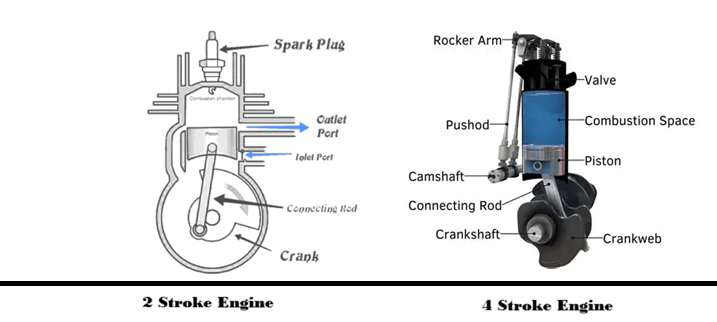
Engines are the heart of automobiles, bikes, generators, and many mechanical machines. Among the most commonly used internal combustion engines are 2 stroke and 4 stroke engines. Both are designed to convert fuel into mechanical energy, but they operate in different ways and serve different purposes.
What is a 2 Stroke Engine?
A 2 stroke engine completes one power cycle in just two strokes of the piston (one crankshaft revolution). It means the engine generates power every time the piston moves up and down once.
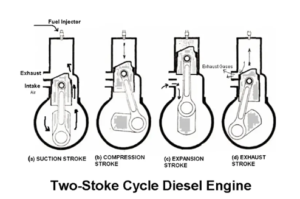
Working Principle of 2 Stroke Engine
The two strokes are:
-
Compression Stroke
-
The piston moves upward.
-
Air-fuel mixture gets compressed inside the combustion chamber.
-
At the top, the spark plug ignites the mixture.
-
-
Power Stroke
-
Combustion pushes the piston downward.
-
Exhaust gases exit, and fresh air-fuel mixture enters almost simultaneously.
-
In a 2 stroke engine, intake and exhaust processes happen together, which makes it mechanically simple and lightweight.
Common Uses of 2 Stroke Engines
2 stroke engines were commonly used in:
-
Older motorcycles and scooters
-
Chainsaws
-
Lawn mowers
-
Small outboard boat motors
Due to stricter emission norms, they are less common in modern vehicles.
What is a 4 Stroke Engine?
A 4 stroke engine completes one power cycle in four strokes of the piston (two crankshaft revolutions). It is the most widely used engine type in modern vehicles.
Working Principle of 4 Stroke Engine
The four strokes are:
-
Intake Stroke
-
Piston moves downward.
-
Intake valve opens.
-
Air-fuel mixture enters the cylinder.
-
-
Compression Stroke
-
Piston moves upward.
-
Air-fuel mixture gets compressed.
-
Spark plug ignites the mixture.
-
-
Power Stroke
-
Combustion pushes the piston downward.
-
This is the main power-producing stroke.
-
-
Exhaust Stroke
-
Piston moves upward.
-
Exhaust valve opens.
-
Burnt gases exit the cylinder.
-
The separation of intake and exhaust processes makes the 4 stroke engine more efficient and cleaner.
Common Uses of 4 Stroke Engines
4 stroke engines are widely used in:
-
Modern motorcycles
-
Cars and SUVs
-
Trucks and buses
-
Generators
-
Agricultural machinery
Almost all modern passenger vehicles use 4 stroke engines.
Key Differences Between 2 Stroke and 4 Stroke Engine
Here are the main differences explained clearly:
1. Number of Strokes
-
2 Stroke Engine: Completes one cycle in 2 strokes.
-
4 Stroke Engine: Completes one cycle in 4 strokes.
2. Power Output
-
2 Stroke: Produces power every crankshaft revolution, so it delivers more power for its size.
-
4 Stroke: Produces power every two crankshaft revolutions.
3. Fuel Efficiency
-
2 Stroke: Less fuel-efficient because fuel can escape with exhaust gases.
-
4 Stroke: More fuel-efficient due to better combustion control.
4. Emission Levels
-
2 Stroke: Produces more smoke and pollution.
-
4 Stroke: Cleaner and environmentally friendly.
5. Engine Design
-
2 Stroke: Simple design, fewer moving parts, no valves.
-
4 Stroke: More complex, includes intake and exhaust valves.
6. Lubrication
-
2 Stroke: Oil is mixed with fuel.
-
4 Stroke: Separate lubrication system for engine oil.
Advantages of 2 Stroke Engine
-
Simple construction
-
Lightweight and compact
-
Higher power-to-weight ratio
-
Lower initial cost
Because of their simple design, 2 stroke engines are easier to repair and maintain.
Disadvantages of 2 Stroke Engine
-
Higher fuel consumption
-
More pollution
-
Shorter engine life
-
Noisy operation
These disadvantages are the reason why many countries have reduced or banned 2 stroke vehicles for regular road use.
Advantages of 4 Stroke Engine
-
Better fuel efficiency
-
Longer engine life
-
Less pollution
-
Smoother and quieter operation
This makes 4 stroke engines ideal for daily commuting and heavy-duty applications.
Disadvantages of 4 Stroke Engine
-
More complex design
-
Heavier than 2 stroke engines
-
Higher manufacturing cost
Despite these drawbacks, their performance and durability make them the preferred choice in modern vehicles.
Which Engine is Better?
The answer depends on usage.
If you need:
-
Lightweight machinery
-
High power in a small engine
-
Simple design
Then a 2 stroke engine may be suitable.
If you want:
-
Better mileage
-
Cleaner emissions
-
Long-lasting performance
Then a 4 stroke engine is the better option.
In today’s automotive industry, 4 stroke engines dominate because of strict emission rules and the demand for fuel efficiency.
Conclusion
Both 2 stroke and 4 stroke engines play an important role in mechanical engineering and the automobile industry. The main difference lies in how they complete their power cycle and manage fuel combustion.
A 2 stroke engine is simple, powerful, and lightweight but less efficient and more polluting. On the other hand, a 4 stroke engine is efficient, durable, and environmentally friendly, making it the standard choice for modern vehicles.
Understanding these engines helps you make better decisions when buying a vehicle or studying automotive technology. Whether you are a student, mechanic, or vehicle owner, knowing the difference between 2 stroke and 4 stroke engines is essential in today’s world.